Today’s News from the Front Lines of the Flamingo Revolution in Albania
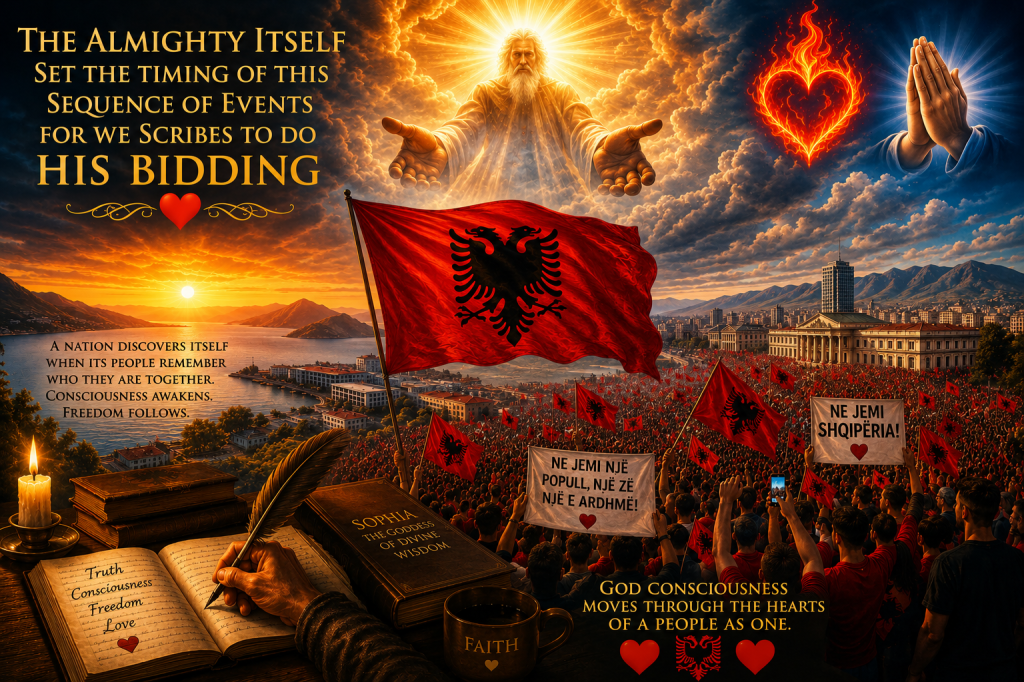
Albania’s Protest Movement Enters a New Phase
By Jonathan P. Wilkie
There are moments when a protest ceases to be merely a protest.
It becomes a movement.
And there are rarer moments when a movement survives long enough for the facts surrounding the controversy that created it to begin changing underneath its feet.
That appears to be what is happening today in Albania.
For more than two months, Albanians have repeatedly taken to the streets in what has become known as the Flamingo Revolution—a movement born from opposition to controversial luxury developments associated with Jared Kushner and Ivanka Trump and from concern about Albania’s extraordinary coastline, protected wetlands and the future of the country’s natural inheritance.
But the Flamingo Revolution is no longer simply about flamingos.
It is no longer simply about a resort.
And it is certainly no longer simply about one parcel of Albanian coastline.
The movement has become a referendum on something much larger:
Who owns Albania’s future?
From a Coastal Dispute to a National Question
The flamingo became an almost perfect symbol for this movement.
The birds gather in Albania’s coastal wetlands, landscapes whose ecological value stands in dramatic contrast to the enormous financial value developers see in the same territory.
One side sees habitat.
Another sees real estate.
But thousands of Albanians have increasingly framed the question differently.
They see inheritance.
They see land, coastline and communities handed from one generation to another. And many are asking whether economic development should be permitted to transform those places without sufficient transparency or public consent.
That argument has resonated far beyond the original development controversy.
Reporting from Le Monde described young Albanians marching under a remarkably simple slogan:
“Albania is not for sale.”
The grievances voiced by demonstrators have expanded accordingly. Protesters interviewed by international media have spoken not merely about environmental preservation, but corruption, public services, housing, economic inequality and the continuing departure of young Albanians seeking opportunities elsewhere.
That is why dismissing the Flamingo Revolution as an environmental protest misses what has happened.
The flamingo may have provided the symbol.
The resort may have provided the spark.
But dissatisfaction with the country’s political and economic system supplied the fuel.
Then the Story Moved Into the Courts
The most important development may now be occurring far from the protest signs and chanting crowds.
Albanian prosecutors have alleged that businessman Artur Shehu, who sold land connected to the proposed development, obtained property using forged deeds. Prosecutors have also accused Shehu of money laundering and involvement in drug smuggling.
Shehu denies the allegations.
Authorities have frozen funds associated with the land sale while the investigation proceeds.
That distinction is important.
An allegation is not a conviction.
Nor is there evidence in this investigation establishing wrongdoing by Jared Kushner, Ivanka Trump or their investment interests.
But politically, the investigation changes the character of the controversy.
For weeks protesters argued that the development represented something fundamentally wrong with the relationship among political power, private wealth and Albania’s natural resources.
Now prosecutors themselves are examining serious allegations surrounding the ownership history of land associated with the development.
That does not prove everything protesters have alleged.
It does mean their questions can no longer simply be waved away as noise from the streets.
Institutions of the Albanian state are asking questions too.
And that represents a significant moment in the evolution of the Flamingo Revolution.
The Diaspora Comes Home
There is another development that may ultimately prove just as important.
The movement is traveling beyond Albania.
Members of the enormous Albanian diaspora have begun returning to participate and demonstrate solidarity.
From Italy, activists have organized journeys across the Adriatic toward Albania. Their message contains perhaps the most profound issue underlying this entire movement:
the right to stay.
Those words deserve attention.
For generations, migration has shaped Albania. Families have watched sons, daughters, brothers and sisters leave for Italy, Germany, Britain, the United States and elsewhere.
People migrate for countless reasons, but economics is among the most powerful.
When young people believe that opportunity exists everywhere except home, a country slowly exports its future.
The Flamingo Revolution therefore raises a question far larger than whether a luxury hotel should be built beside a lagoon.
What kind of Albania will young Albanians inherit?
Will they inherit a country where they can afford to live, work, raise families and participate in the prosperity created from their own nation’s resources?
Or will they inherit beautiful coastlines increasingly accessible only to those wealthy enough to purchase admission?
When members of the diaspora cross the Adriatic to stand beside protesters at home, the political meaning changes.
They are no longer merely emigrants looking backward.
They are citizens and descendants looking forward.
A Movement That Refused to Disappear
Political leaders everywhere understand one basic fact about demonstrations:
Most eventually end.
People become tired.
Jobs demand attention.
Families need care.
Weather changes.
Crowds diminish.
Television cameras move elsewhere.
Time itself becomes one of government’s most powerful political tools.
Wait long enough, and perhaps the streets will empty.
But persistence changes that calculation.
The Flamingo Revolution has survived week after week.
There have been peaceful demonstrations and moments of confrontation. In July, tensions outside parliament escalated sufficiently for Albanian police in riot gear to use water cannon and tear gas while some protesters threw eggs and bottles.
That escalation should not become the identity of the movement.
The more remarkable fact is how long Albanians have continued appearing.
A democratic protest movement ultimately derives its legitimacy not from violence but endurance—from citizens repeatedly insisting that their government hear them.
That endurance has transformed what might once have been dismissed as a local development dispute into an international story.
This Is Not an Anti-American Revolution
There is another distinction worth making.
Albania has historically maintained extraordinarily warm feelings toward the United States.
The present controversy should therefore not automatically be interpreted as Albanian hostility toward America.
The argument is more specific.
It concerns development, sovereignty, transparency, environmental protection and the relationship between citizens and powerful investors—foreign or domestic.
Jared Kushner and Ivanka Trump have become internationally recognizable figures associated with the controversy because of their connection to the proposed development.
But the deeper question belongs entirely to Albania.
A sovereign nation has every right to welcome investment.
Investment can create employment, infrastructure and prosperity.
But investment and sovereignty must coexist.
Economic development cannot become a synonym for citizens losing meaningful influence over the places in which they live.
The most successful development occurs when investors, government and local communities can all say afterward:
We benefited.
When only one side believes that, something has gone wrong.
The Government’s Choice
Prime Minister Edi Rama has strongly supported the development projects and has characterized the demonstrations as politically motivated.
He now confronts a difficult decision.
He can continue treating the movement primarily as opposition politics.
Or he can recognize that something larger has emerged.
Governments sometimes make the mistake of believing that acknowledging protesters demonstrates weakness.
Democracy suggests precisely the opposite.
Listening is not surrender.
Transparency is not surrender.
Investigating disputed property ownership is not surrender.
Protecting irreplaceable natural resources is not surrender.
These are functions of legitimate government.
And if the development is ultimately demonstrated to be lawful, environmentally responsible and beneficial to Albania, transparency should strengthen that case rather than weaken it.
Sunlight is not the enemy of legitimate development.
It is its best defense.
The Front Lines Have Changed
When I first began following the Flamingo Revolution, the most visible front line was easy to identify.
It was the street.
Today there are at least three.
The first remains the streets of Albania, where citizens continue demanding accountability.
The second is the legal front, where prosecutors and courts are examining serious allegations concerning property ownership and financial transactions connected with land associated with the proposed development.
And the third is the diaspora, where Albanians who built lives beyond their homeland are discovering that physical distance does not eliminate their stake in Albania’s future.
Those three forces—citizens, institutions and diaspora—now intersect.
That is why this moment deserves international attention.
What Happens Next?
No one should pretend the outcome is predetermined.
The government has not fallen.
The development has not simply disappeared.
The legal allegations remain allegations that must be tested through due process.
And protest movements themselves can fracture, lose momentum or be captured by competing political interests.
But something important has already happened.
Albanians have demonstrated that citizens who believe their natural inheritance and political institutions are being mishandled can force the world to pay attention.
The flamingo has consequently become more than a bird inhabiting an endangered wetland.
It has become a symbol.
A symbol of land.
A symbol of belonging.
A symbol of young people asking whether remaining in their homeland can still be a viable dream.
And now a symbol recognized by Albanians returning across borders to stand beside those who never left.
The international community should continue watching Albania carefully—not because outsiders should decide Albania’s future, but for exactly the opposite reason.
Albanians must be allowed to decide Albania’s future.
That is the story emerging from the front lines.
The Flamingo Revolution began with a threatened landscape.
It grew into a protest against corruption and political power.
It has now reached prosecutors, courts and Albanians living beyond the country’s borders.
Where it ends remains unknown.
But after more than two months, one conclusion is increasingly difficult to dispute:
The flamingos have not flown away.
And neither have the people defending what they believe belongs to Albania’s future
—
Jonathan P. Wilkie
Worldevents8
© 2026 Jonathan P. Wilkie. All Rights Reserved.
By:
Posted in:
 worldevents8